

Why Your Ag Guidance System "Pulls" the Tractor Off Line by 1–1.5 m - and How to Fix It
19.12.2025
- A common issue with budget ag guidance systems
- Main causes of inconsistent accuracy
- 1. A low-quality GPS/GNSS receiver
- 2. Limited SBAS performance in Ukraine
- Practical solutions
- Solution #1. RTK — maximum accuracy
- Solution #2. GM SMART and GM PRO S GNSS receivers with a DP filter
- What a DP filter is — and why it works
- What this looks like in the field
- A typical GPS receiver
- GM SMART / GM PRO S with DP filtering
- What farmers gain with GM SMART / GM PRO S
- Real-world advantages of GM SMART / GM PRO S
- Table 1. Accuracy comparison of guidance technologies
- Table 2. Which solution fits which job
A common issue with budget ag guidance systems

This situation is very common: a farmer installs an affordable ag guidance system with a GPS/GNSS receiver, and the first pass across the field looks perfectly acceptable. The tractor drives straight, overlap is minimal, and everything seems fine.
But by the second or third pass, the problem shows up: the guidance line starts to drift, and the tractor can be pulled off the intended path by 1–1.5 meters (or more).
It’s especially noticeable in this scenario:
-
In one direction, the tractor drives more or less straight.
-
After turning around and driving back, the navigator shows the wrong heading.
- As a result of unstable heading calculation, the guidance system suggests an incorrect direction. The tractor ends up driving at a slight angle instead of parallel to the previous pass—and that angle can keep changing. Over distance, the error accumulates and leads to a 1–1.5 m (or greater) lateral deviation, even on a flat, level field.
Meanwhile:
-
the field is flat,
-
there are no slopes,
-
and the operator is driving carefully.
So why does this happen?
Main causes of inconsistent accuracy
1. A low-quality GPS/GNSS receiver
Many entry-level systems use GNSS receivers that:
-
struggle to determine a stable heading and direction of travel;
-
estimate direction only from coordinate changes, without properly accounting for vehicle dynamics;
-
behave inconsistently when direction changes (especially after a turn).
As a result, the system “thinks” the tractor is moving in a different direction than it actually is.
2. Limited SBAS performance in Ukraine
You’ll often hear:
“We have SBAS / EGNOS — that should be enough.”
In practice:
-
SBAS can be inconsistent in Ukraine;
-
in many regions it provides little to no real improvement;
-
errors can still remain at the 1–2 meter level, especially while moving.
So even with SBAS enabled, the “pass-to-pass drift” issue often doesn’t go away.
Practical solutions
Solution #1. RTK — maximum accuracy
RTK (Real-Time Kinematic) is a technology that uses:
-
paid GNSS correction services (via the Internet or a local base station),
-
carrier-phase measurements from satellites.
RTK advantages:
-
centimeter-level accuracy (typically 2–3 cm);
-
excellent repeatability from pass to pass;
-
ideal for autosteer and row-crop operations.
Limitations:
-
requires paid corrections;
-
depends on Internet coverage or a base station;
-
higher total system cost.
Solution #2. GM SMART and GM PRO S GNSS receivers with a DP filter
For many farmers, RTK can be overkill—or simply too expensive for the job.
That’s why we developed the GM SMART GNSS receiver, and later the GM PRO S, specifically for precision farming.
The key feature of GM SMART / GM PRO S is a built-in DP filter.
What a DP filter is — and why it works
DP (Differential Positioning) filtering is a software algorithm that:
-
does not treat GNSS positions as isolated “points,”
-
but instead analyzes the tractor’s motion as a continuous trajectory.
It takes into account:
-
speed,
-
acceleration,
-
heading,
-
previous position,
-
changes in the GNSS carrier phase (without requiring a full RTK solution).
What this looks like in the field
A typical GPS receiver
-
each position is calculated independently;
-
heading errors appear when direction changes;
-
parallel passes start to spread apart or drift.
GM SMART / GM PRO S with DP filtering
-
Smooths the position over time, reducing short-term “jumps”.
-
Uses a realistic motion model—a tractor cannot instantly shift by a meter.
-
Stabilizes carrier-phase behavior across satellites.
-
Analyzes the velocity vector to determine direction and heading more reliably.
The result is that parallel passes remain consistent, even if the absolute position of the entire map drifts slightly (for example, by ~1 m over a day).
What farmers gain with GM SMART / GM PRO S
For most farming tasks:
-
spraying,
-
fertilizer spreading,
-
cultivation,
-
pre-seeding tillage,
centimeter-level absolute accuracy is not required.
What matters most is that passes stay consistent relative to each other.
Real-world advantages of GM SMART / GM PRO S
-
10–15 cm pass-to-pass repeatability;
-
no RTK, no base station, no NTRIP required;
-
a more stable guidance line after headland turns;
-
simplicity and a lower total cost.
Table 1. Accuracy comparison of guidance technologies
| Technology | Absolute accuracy |
Pass-to-pass repeatability
(from one pass to the next)
|
Notes |
|---|---|---|---|
| Standard GPS | 1–3 m | 1–1.5 m | Unstable heading; drift often becomes obvious after turning |
| GPS + SBAS (EGNOS) | 0.8–1.5 m | 0.8–1.2 m | In Ukraine, improvements are often small or inconsistent |
| GM SMART / GM PRO S (DP filter) | ~1 m | 10–15 cm | High pass-to-pass stability without RTK |
| RTK | 2–3 cm | 2–3 cm | Maximum accuracy; requires corrections |
Table 2. Which solution fits which job
| Type of field work | Recommended technology | Why |
|---|---|---|
| Spraying | GM SMART / GM PRO S | High repeatability without the cost and complexity of RTK |
| Fertilizer spreading | GM SMART / GM PRO S | Stable guidance, reduced overlap |
| Cultivation / disking | GM SMART / GM PRO S | Centimeter-level absolute accuracy is not required |
| Seeding without autosteer | GM SMART / RTK | Depends on implement width and acceptable tolerance |
| Row crops / autosteer | RTK | Maximum accuracy and repeatability are required |
| Surveying / mapping | RTK | The only correct choice for high-precision work |
The 1–1.5 meter drift you see in the field is not a "crooked field" and it’s usually not the operator’s fault.
In most cases, the cause is the limitations of entry-level GNSS hardware and unstable heading determination.
So if:
-
you need maximum accuracy, choose RTK;
-
you want stable passes without unnecessary cost, GM SMART / GM PRO S with DP filtering is an excellent choice.
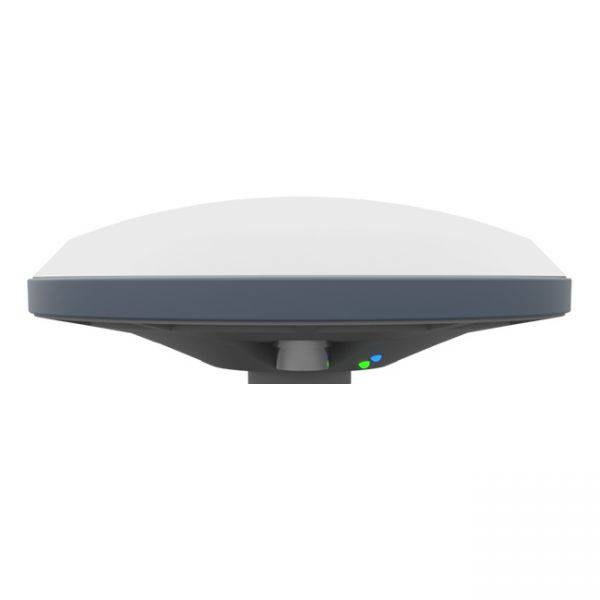
GM SMART GNSS receiver is a new generation receiver for working with any navigation programs and the ability to increase accuracy up to 1 cm. It has 335 channels to work with all available satellite systems: GPS, GLONASS, GALILEO, BEIDOU, QZSS, IRNSS, SBAS.
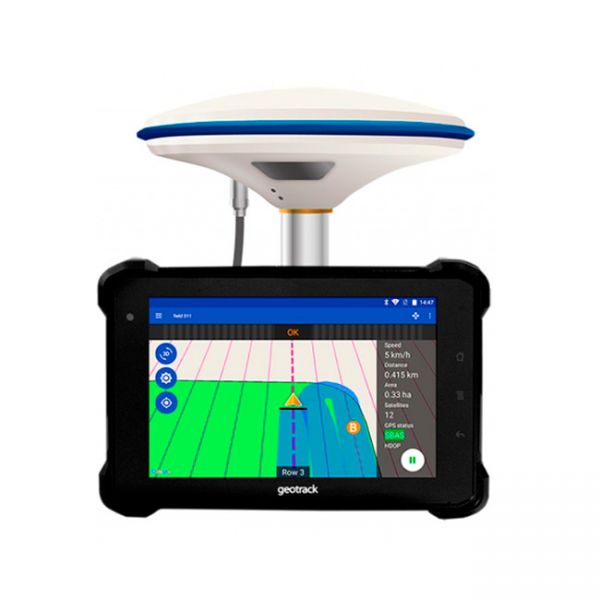
Agricultural guidance system geotrack explorer PLUS is a new development by Geometer company, which provides 15 cm of accuracy from pass-to-pass, and the ability to connect to RTK and obtain an accuracy of 1-3 cm.
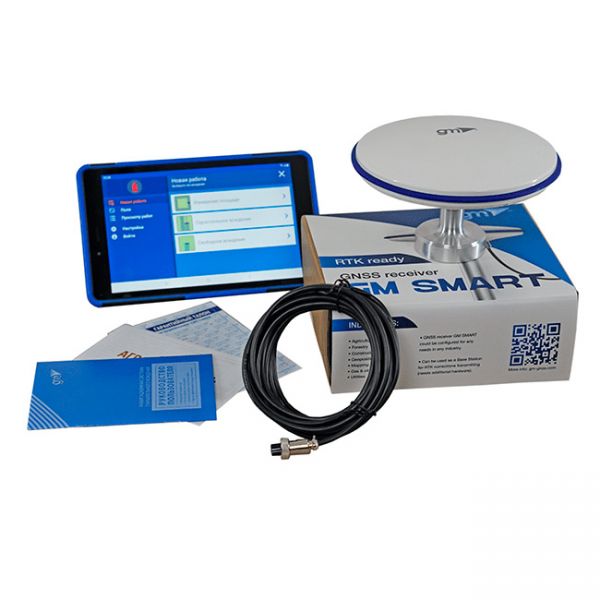
Agricultural guidance system geotrack Lite is based on Samsung's 8.7-inch display, geotrack software and GM SMART receiver. The receiver has 335 channels to work with all available satellite systems: GPS, GLONASS, GALILEO, BEIDOU, QZSS, SBAS. Provides accuracy of tractor guidance, at the level of 15 cm from pass-to-pass. The GM SMART receiver has a special software smoothing filter, which was developed for use in agriculture. Thanks to the smoothing mode feature high accuracy of parallel driving is provided.