

High Performance of the Compact GNSS RTK Receiver Walker 2 IMU in Real-World Conditions
04.02.2026
Modern GNSS RTK measurements are not only about the nominal accuracy “down to a centimeter.” In real field conditions, the decisive factors are receiver performance, RTK fix acquisition speed, stability when operating over long distances, and the ability to adapt to complex infrastructure conditions. This is exactly where Walker 2 IMU demonstrates advantages that were previously associated only with large and expensive professional systems.
High performance: what it means in practice
The GNSS receiver Walker 2 IMU is equipped with 1408 channels and a high-quality multi-frequency GNSS antenna.
These are not just numbers in a specification — they have a direct impact on:
- the speed of carrier-phase ambiguity resolution;
-
efficient processing of a large number of satellites;
-
stable RTK FIX at long distances;
-
resistance to noise, multipath, and signal attenuation.
The video showing the 100 km base connection is available here . For many professionals, this may seem like an unusual or even “impossible” scenario — yet such conditions are becoming increasingly common in practice.

RTK operation under unstable infrastructure conditions
In certain regions of Ukraine, RTK base stations are unevenly distributed, and their availability is not always stable. Some stations are powered down due to damage to energy infrastructure, others have been lost as a result of military actions together with the territories, or are physically inaccessible for restoration and return to operation within RTK networks.
Under such conditions, GNSS users are often forced to work with remote base stations, sometimes tens of kilometers farther than what was considered normal in peacetime. This significantly increases the requirements for receiver performance, carrier-phase ambiguity resolution speed, and the stability of obtaining RTK FIX.
That is why the ability of a GNSS RTK receiver to operate reliably at large distances from the base station is no longer a rare scenario, but a practical necessity for professionals who continue working in real — not ideal — conditions.
Comparison with older-generation branded receivers
In practice, many branded GNSS receivers released before 2020 are still widely used.
Such systems often feature:
-
a significantly lower number of channels;
-
limited support for modern GNSS signals;
-
slow carrier-phase processing algorithms.
In the field, this typically results in:
-
a base distance of 30–40 km;
-
RTK FIX waiting times of 3–5 minutes;
-
unstable switching between FLOAT and FIX;
-
loss of time and operator frustration.
Formally, these are considered “professional” receivers, but in reality their architecture no longer meets modern requirements.
Against this background, Walker 2 IMU clearly demonstrates how far GNSS technology has advanced over the past five years.

Small body — high performance
It is worth emphasizing that Walker 2 IMU remains a compact, lightweight, and user-friendly GNSS RTK receiver, despite its high computational and navigation performance. Its non-traditional exterior design may differ from classic geodetic receivers, yet in terms of capability it is in no way inferior and in some scenarios even surpasses them in usability.
The receiver does not require:
-
bulky external antennas;
-
large controllers or additional hardware blocks;
-
complex or time-consuming configuration before operation.
At the same time, Walker 2 IMU provides:
-
fast startup and readiness for work;
-
stable acquisition of RTK FIX;
-
confident operation even in challenging field scenarios.
A key advantage is the presence of an integrated IMU sensor, which compensates for pole tilt and improves measurement accuracy in situations where it is not possible to keep the pole perfectly vertical. This is especially important when surveying in confined spaces, near obstacles, or during dynamic field work.
In addition, Walker 2 IMU is fully compatible with and intuitively controlled by the SurPad 4.2 geodetic software, allowing users to quickly master the system without lengthy training. A clear interface, logical menu structure, and a wide set of tools make the system convenient for both experienced professionals and those transitioning from older equipment.
In today’s world, more and more users prefer lightweight and compact solutions that reduce physical strain and increase field mobility. Replacing the bulky and heavy receivers that were common more than 10 years ago are modern devices that combine high performance, ergonomics, and usability.
Walker 2 IMU is a clear example of a modern approach to GNSS RTK equipment, where compactness is combined with high performance, and convenience with professional capabilities.
The ability to obtain RTK FIX at a distance of nearly 100 km in 120 seconds is not a record for the sake of a record, nor a laboratory experiment. It is a demonstration of real computational power and algorithm efficiency, which directly affect speed and stability in the field.
In real conditions — with limited infrastructure, remote base stations, and unstable environments — these characteristics become decisive. They allow professionals to work without downtime, avoid long RTK FIX waiting times, and remain independent of ideal conditions.
Walker 2 IMU demonstrates how modern GNSS architecture makes it possible to:
-
work where other receivers force users to wait;
-
reduce dependence on RTK infrastructure density and availability;
-
achieve results faster, more stably, and with greater confidence.
Such solutions are shaping a new standard for field GNSS RTK measurements — lightweight, mobile, and ready for real-world challenges, not just ideal conditions.
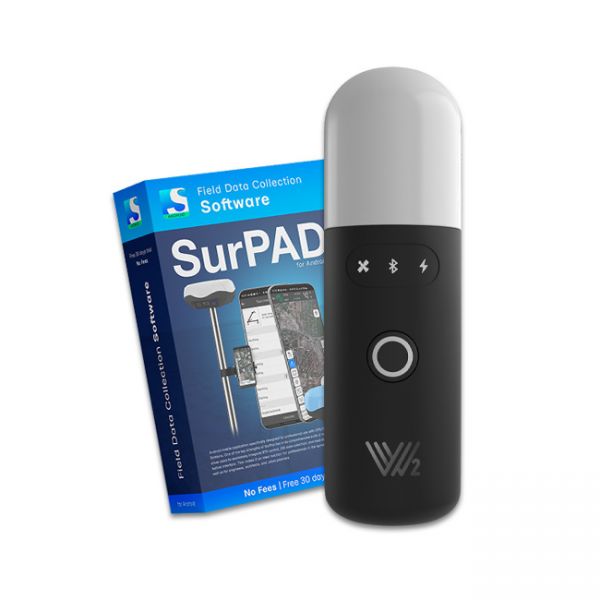
The Walker 2 receiver is an exceptionally lightweight and compact GNSS RTK device, weighing only 220 grams, designed for convenient use in any field conditions. Its sealed and shock-resistant housing withstands drops from heights up to 1.6 meters, ensuring reliability on construction sites, in agriculture, and in challenging terrain.
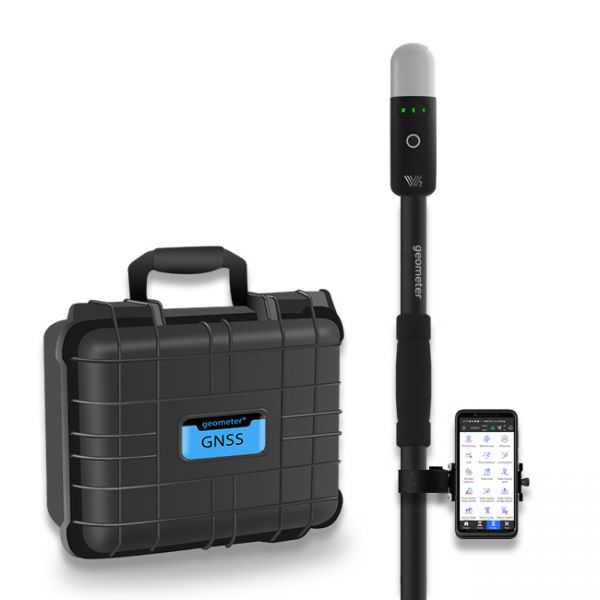
The Walker 2 IMU GNSS RTK Kit is a powerful and ultra-light GNSS RTK solution for professional measurements with centimeter-level accuracy. The Walker 2 IMU KIT comes in a shockproof case.
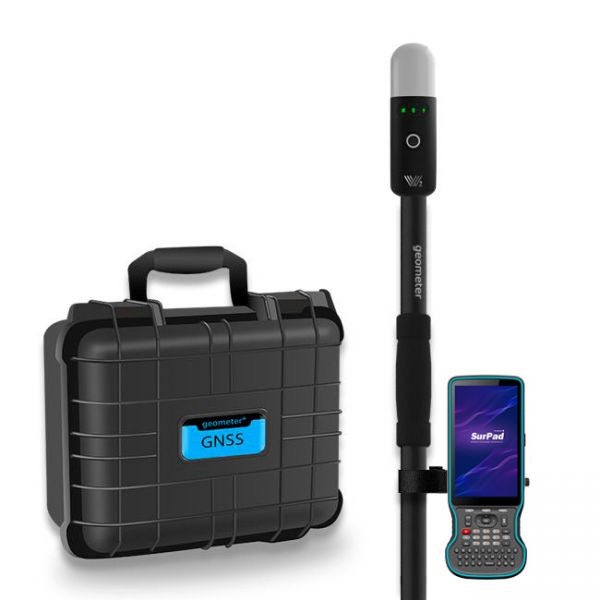
The Walker 2 IMU GNSS RTK kit with the Y55 controller is a powerful and ultra-light geodetic GNSS RTK solution for professionals.